
Report Overview
Description
Microgrid Market Size
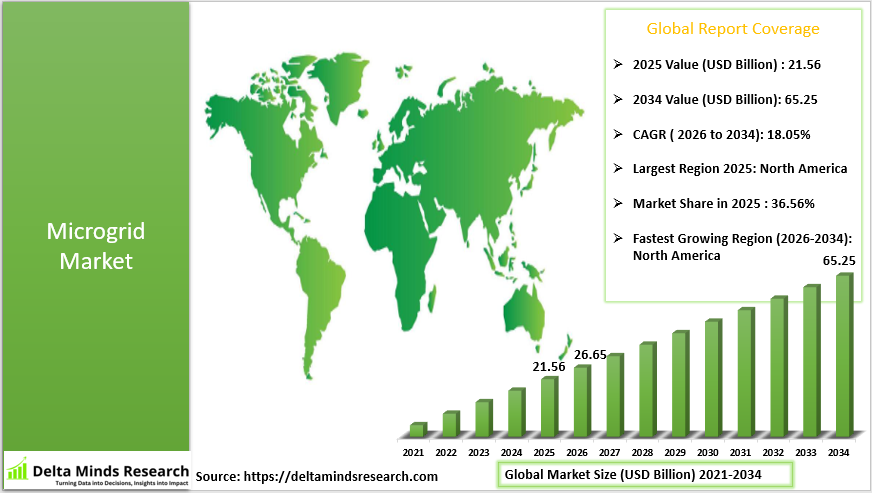
The global Microgrid Market was valued at USD 21.56 Billion in 2025. The market is estimated to grow from USD 26.65 Billion by end of 2026 to USD 65.25 Billion till 2034 growing at a Compound Annual Growth Rate (CAGR) of 18.05% during the forecast period 2026 to 2034. North America holds the largest market share of 36.56% in 2025.
Microgrids are becoming an increasingly important part of modern electricity infrastructure as utilities, industrial facilities, commercial establishments, communities, healthcare organizations, campuses, and remote locations seek greater control over electricity generation and consumption. Unlike conventional electricity networks that depend primarily on centralized generation and long-distance transmission, a microgrid coordinates distributed energy resources within a defined local network.
Depending on system design, a microgrid can incorporate solar photovoltaic systems, conventional generators, natural gas generation, fuel cells, battery energy storage, power-conversion equipment, and intelligent energy-management technologies. Grid-connected configurations can exchange electricity with the wider utility network, while island able and off-grid systems can maintain local electricity supply independently when required.
The market is consequently evolving beyond basic distributed power generation. Modern microgrids increasingly combine generation assets with battery storage, digital controllers, smart meters, sensors, forecasting systems, and automated energy-management software. This allows operators to balance generation and consumption, manage distributed resources, respond to grid conditions, and improve the utilization of locally generated electricity.
Demand is being supported by three interconnected priorities: energy resilience, renewable-energy integration, and decentralization of electricity infrastructure. Organizations requiring highly reliable electricity are considering microgrids as a means of reducing exposure to grid disruptions, while businesses and communities pursuing renewable-energy strategies are using microgrids to coordinate distributed solar, storage, and other energy resources.
Major companies participating in the broader microgrid ecosystem include Siemens, General Electric, Schneider Electric, Honeywell, ABB, Eaton, S&C Electric Company, Enel X, and other technology and energy-infrastructure providers.
Key Microgrid Market Takeaways:
Market Size & Growth
- 2025 Market Size: USD 21.56 Billion.
- 2026 Market Size: USD 26.65 Billion.
- 2034 Market Size: USD 65.25 Billion.
- CAGR (2026-2034): 18.05%.
Regional Leadership
- Largest Market Share Holder Region in 2025: North America (Holds Market Share of 36.56%).
- Fastest Growing Region during forecast years (2026-2034): North America.
List of Key Microgrid Market Companies Profiled in the Report
- Siemens, General Electric, Schneider Electric, Honeywell, ABB, Eaton, Microgrid Energy, S&C Electric Company, Enel X.
This report focuses on Microgrid Market revenue at the global, regional, and country level. From global perspective, this report represents overall Microgrid Market size, by analyzing historical data, and prospects. Regionally, this report focuses on Several Key region: North America, Europe, Asia Pacific, South America, and Middle East and Africa.
Key Points Covered in the Report
- Market Revenue of Microgrid Market from 2021 to 2034
- Market Forecast for Microgrid Market from 2026 to 2034
- Regional Market share and revenue from 2021 to 2034
- Countries Level Market share within region from 2021 to 2034
- Company Market share analysis, competitive scenario, ranking, and detailed company profiles.
- Market drivers, Market restraints, and detailed COVID-19 impact on Microgrid Market.
Market Dynamics
Decentralized Electricity Systems Are Changing the Structure of Power Generation
Electricity infrastructure has traditionally been designed around centralized generating facilities supplying consumers through transmission and distribution networks. The expansion of distributed energy resources is gradually creating a more decentralized model. Solar installations, battery storage, distributed generators, fuel cells, and other localized resources can now be coordinated within a microgrid rather than operating as independent assets.
This architecture can provide users with greater flexibility over when electricity is generated, stored, purchased from the grid, or consumed locally. For commercial and industrial facilities, decentralization can also provide greater visibility into electricity costs and energy utilization. Communities and remote locations can use similar systems to develop localized electricity networks where conventional grid infrastructure is unavailable, unreliable, or expensive to extend.
Digital Energy Management Is Expanding Microgrid Capabilities
The growing sophistication of control technologies is transforming the operational role of microgrids.
Modern energy-management platforms can collect information from distributed generators, batteries, meters, loads, weather forecasts, and grid connections. This information can then be used to determine how available energy resources should operate under changing conditions.
Advanced controllers can help determine when batteries should charge or discharge, when local generation should operate, when electricity should be imported from the grid, and which loads should receive priority during constrained operating conditions. IoT-enabled devices, smart meters, sensors, cloud-based platforms, and increasingly sophisticated analytics are therefore becoming important parts of the microgrid technology stack. This digital layer is particularly important as microgrids incorporate a larger number of variable and distributed resources.
Microgrid Market Drivers:
Increasing Need for Reliable and Resilient Electricity Infrastructure
Energy resilience has become an important consideration for organizations that cannot tolerate prolonged electricity interruptions. Healthcare facilities, manufacturing plants, data centers, military facilities, public infrastructure, universities, emergency-response centers, and other critical operations can face significant operational or financial consequences when grid electricity becomes unavailable. Microgrids provide an alternative architecture by allowing selected generation and storage resources to be coordinated locally. Systems designed with islanding capabilities can separate from the wider electricity network under certain operating conditions and continue serving designated loads.
This capability makes microgrids particularly relevant to facilities where electricity continuity has strategic or operational importance. Growing concern about extreme weather, natural disasters, aging grid infrastructure, and other causes of electricity disruption is consequently strengthening the business case for resilient local-energy systems.
Renewable-Energy Expansion Is Increasing Demand for Local Energy Management
The rapid deployment of renewable generation represents another important market driver. Solar and wind generation introduce variability into electricity production because output changes according to weather and environmental conditions. Microgrid architectures can help manage this variability by coordinating renewable generation with energy storage, conventional generation, controllable loads, and grid electricity. For example, electricity generated by solar installations during periods of strong production can be consumed locally or stored in batteries for later use. Energy-management systems can subsequently coordinate stored electricity with other generation resources when renewable production declines.
Microgrids can therefore enable organizations to integrate a larger proportion of distributed renewable generation while maintaining greater control over electricity reliability and consumption.
Energy Storage Is Strengthening Microgrid Performance
Improvements in battery energy-storage technology are expanding the capabilities of microgrid systems. Storage can perform several functions within a microgrid. It can absorb excess renewable generation, supply electricity during periods of high demand, support islanded operation, reduce short-term fluctuations, and help operators manage the timing of grid electricity purchases. The relationship between storage and microgrids is particularly important for renewable-heavy systems. Without storage or another flexible energy resource, differences between renewable generation and electricity demand can limit system performance. As battery systems become increasingly integrated with distributed energy projects, storage is expected to remain a central component of many new microgrid configurations.
Grid Modernization Is Creating a More Favorable Environment for Microgrid Integration
Electricity networks in many markets are undergoing modernization as utilities and governments invest in digital grid technologies. Smart meters, automated distribution equipment, communication networks, advanced monitoring systems, and distributed-energy management platforms can improve coordination between microgrids and the wider electricity network. This modernization is important because future microgrids are unlikely to operate entirely independently of utility infrastructure. Grid-connected systems can potentially provide benefits both to their owners and to electricity networks through demand management, distributed generation, storage, and other grid-support functions where regulations permit. As electricity networks become more digitally connected, the interaction between utilities, distributed energy resources, and microgrids is expected to become increasingly sophisticated.
Policy Support Can Accelerate Microgrid Deployment
Public-sector programs can influence microgrid economics through grants, incentives, demonstration programs, resilience initiatives, renewable-energy policies, and grid-modernization investments. Policy support is particularly relevant where microgrids are being deployed for critical infrastructure, remote electrification, disaster preparedness, clean-energy integration, or community resilience. However, the regulatory environment differs considerably among countries and even among states or provinces within individual countries. Market development therefore depends not only on technology economics but also on electricity-market structures, interconnection requirements, utility regulations, and rules governing distributed generation.
Microgrid Market Opportunities:
Commercial and Industrial Energy Resilience Creates Significant Expansion Potential
Industrial and commercial facilities represent an important long-term opportunity for microgrid developers. Manufacturing plants, warehouses, logistics facilities, data centers, mining operations, commercial campuses, and other energy-intensive facilities increasingly require electricity systems that combine reliability with cost management and sustainability objectives. Microgrids can allow these organizations to integrate onsite generation and storage while coordinating their interaction with utility electricity. For industries where electricity interruptions can stop production, damage equipment, disrupt digital operations, or affect product quality, the economic value of improved resilience can be substantial.
Remote Electrification Can Expand Off-Grid Microgrid Deployment
Large populations and industrial operations remain located in areas where conventional electricity networks are difficult or costly to extend. Off-grid microgrids can provide an alternative by combining locally available generation with storage and control systems. Mining sites, islands, rural communities, telecommunications infrastructure, construction projects, and remote industrial facilities represent potential applications.
Historically, many isolated electricity systems depended heavily on diesel generation. Hybrid microgrids incorporating solar PV, batteries, and other resources can reduce fuel consumption while maintaining dispatchable generation for periods when renewable electricity is unavailable.
Artificial Intelligence and Advanced Analytics Could Create New Software Opportunities
The next stage of microgrid development is expected to involve increasingly intelligent energy management. Advanced analytics can process data relating to weather, electricity prices, battery status, expected consumption, renewable generation, equipment performance, and grid conditions.
These capabilities can enable predictive rather than purely reactive operation. For example, a controller could anticipate periods of high electricity prices and charge batteries beforehand, forecast lower solar production and preserve stored energy, or identify abnormal equipment behaviour before a failure occurs. This creates opportunities for software providers alongside traditional electrical-equipment manufacturers.
Microgrid Market Segmentation Analysis
For this study, we have categories the Microgrid Market By Type, By Component Type, By Power Source Type, By End Use Type and By Region.
By Type
Based on Type, the market is segmented into Grid Connected, Off-Grid.
Grid-Connected Microgrids Represent a Major Deployment Category
Grid-connected microgrids operate in conjunction with the wider electricity network while coordinating onsite generation, storage, and loads.
Their ability to use existing grid infrastructure while simultaneously managing distributed resources makes them particularly relevant to urban, commercial, institutional, and industrial applications.
Under normal conditions, these systems can exchange electricity with the utility network. Depending on their technical configuration, selected microgrids can also disconnect from the main network during outages and continue serving designated local loads. This combination of grid access and local control supports adoption among organizations seeking resilience without completely separating themselves from utility infrastructure.
Off-Grid Systems Address Remote and Isolated Electricity Requirements
Off-grid microgrids serve locations where connection to a centralized electricity network is unavailable, unreliable, or economically unattractive. These systems can integrate multiple resources—including solar generation, diesel generators, batteries, natural gas generation, or other technologies—to provide localized electricity.
Their modular characteristics make off-grid microgrids particularly relevant to islands, rural communities, mining sites, remote industrial operations, and other isolated applications. Growing renewable-energy deployment and improvements in storage technology are creating opportunities to reduce the dependence of remote systems on conventional fuel-based generation.
By Component Type
Based on Component Type, the market is segmented into Hardware, Software, Services.
Hardware Forms the Physical Foundation of Microgrid Infrastructure
Hardware encompasses the equipment required to generate, convert, store, distribute, measure, and control electricity within a microgrid.
Depending on system architecture, this can include distributed generators, solar PV systems, battery storage, inverters, switchgear, transformers, controllers, protection systems, meters, and communication equipment. The capital-intensive nature of this infrastructure makes hardware an important component of overall project expenditure.
Software Is Becoming Increasingly Important to System Optimization
As microgrids incorporate more distributed resources, the complexity of operating those assets increases.
Energy-management software provides the intelligence required to coordinate generation, storage, electricity demand, and interaction with the utility grid. Digital platforms can monitor system performance, forecast energy requirements, optimize dispatch, manage battery charging, and provide operators with visibility across multiple energy assets.
Software is therefore transitioning from a supporting component toward a strategically important layer of modern microgrid infrastructure.
Services Support Increasingly Complex Microgrid Deployments
Microgrid projects require expertise across system design, engineering, integration, commissioning, optimization, maintenance, and ongoing operation.
As deployments become more sophisticated, customers increasingly require specialized technical support to integrate equipment from different manufacturers and manage complex combinations of renewable generation, batteries, conventional generation, and digital controls. This creates opportunities for engineering companies, system integrators, consultants, operations providers, and specialized energy-service companies.
By Power Source Type
Based on Power Source Type, the market is segmented into Natural Gas, Solar PV, Diesel, Fuel Cell.
The role of individual power sources varies considerably according to application, geography, fuel availability, reliability requirements, and system design.
Solar PV has become increasingly important because it provides a modular source of onsite renewable electricity and can be integrated with battery storage.
Natural gas generation can provide dispatchable electricity for systems requiring stable and controllable output, particularly where gas infrastructure is already available.
Diesel generation continues to play a role in backup and remote-power applications because of its established technology base and dispatchability, although many hybrid projects are attempting to reduce diesel consumption through renewable generation and storage.
Fuel cells represent another option for applications requiring distributed electricity with specific emissions, reliability, or operational requirements.
Importantly, many microgrids are hybrid systems rather than single-source installations. Future market development is therefore expected to depend increasingly on the optimization of multiple generation and storage technologies within one coordinated system.
By End Use Type
Based on End Use Type, the market is segmented into Industrial, Microgrid Market.
Healthcare Applications Require Exceptional Power Reliability
Hospitals and other healthcare facilities represent an important application because continuous electricity supply is essential for medical equipment, clinical operations, refrigeration, communications, digital systems, and patient safety.
Traditional backup generators provide emergency electricity, but microgrids can expand resilience by coordinating several energy resources within an integrated architecture. Renewable generation, batteries, conventional backup systems, and intelligent controls can be combined to support critical loads during grid interruptions while providing energy-management benefits during normal operations.
Industrial Microgrids Are Emerging as an Important Growth Area
Industrial facilities increasingly require electricity solutions capable of balancing reliability, operating costs, sustainability, and energy independence.
Manufacturing interruptions caused by power failures can result in lost production and substantial financial costs. Microgrids can help mitigate this exposure while enabling facilities to integrate onsite renewable generation and energy storage. The increasing electrification of industrial processes and corporate decarbonization commitments could further strengthen demand for sophisticated industrial microgrid systems.
Microgrid Market Regional Outlook
By Geography, the market is categorized into North America, Europe, Asia Pacific, South America and Middle East and Africa.
North America Microgrid Market Growth & Analysis Report 2026-2034
North America represented the largest regional microgrid market in 2025, accounting for approximately 36.56% of global revenue. The region combines several conditions favorable to microgrid deployment: significant distributed-energy investment, growing renewable-generation capacity, established technology suppliers, sophisticated electricity infrastructure, resilience requirements, and ongoing grid-modernization initiatives.
The United States represents a major share of regional activity, with microgrids being deployed across commercial and industrial facilities, healthcare institutions, universities, military installations, public infrastructure, communities, and other critical facilities. Energy resilience has become particularly important in areas exposed to hurricanes, wildfires, storms, extreme temperatures, and other events capable of disrupting electricity networks.
Canada also represents an important regional opportunity, particularly for renewable-energy integration, industrial facilities, remote communities, and locations where conventional grid expansion can be economically challenging. The presence of established energy-technology companies and specialized microgrid developers further supports the development of the North American ecosystem.
Europe Microgrid Market Growth & Analysis Report 2026-2034
Europe accounted for approximately 28.50% of the global microgrid market.
The region’s development is closely connected with renewable-energy expansion, distributed generation, electrification, energy security, and the modernization of electricity infrastructure. Germany, the United Kingdom, France, and other European markets are increasing the deployment of distributed solar, storage, electric-vehicle infrastructure, and intelligent energy-management technologies.
Microgrids can provide a platform for coordinating these assets at industrial sites, commercial facilities, communities, campuses, and other localized energy systems. Energy security has also become an increasingly important consideration across Europe. Local generation and storage can provide organizations with greater flexibility over their energy supply while supporting broader decarbonization objectives. As distributed-energy penetration increases, software and grid-management technologies are expected to become increasingly important to European microgrid deployment.
Asia Pacific Microgrid Market Growth & Analysis Report 2034
Asia Pacific accounted for approximately 21.65% of the global microgrid market. The region presents a diverse range of microgrid opportunities due to differences in electricity infrastructure, economic development, population density, industrialization, and renewable-resource availability.
China and India represent major potential markets because of their large electricity systems, growing power demand, renewable-energy expansion, and investment in smart-grid technologies. In densely populated and industrialized areas, microgrids can support commercial facilities, factories, campuses, and distributed-energy integration. In rural and remote locations, they can provide electricity where centralized grid infrastructure is limited.
Island markets and geographically isolated communities across the wider Asia Pacific region create additional opportunities for hybrid and off-grid microgrids. As renewable generation, battery storage, and digital energy-management technologies become more accessible, microgrids are expected to play a broader role in regional electricity infrastructure.
South America Microgrid Market Growth & Analysis Report 2034
South America represents an emerging opportunity for microgrid deployment as countries expand renewable-energy generation and seek improved electricity reliability across industrial, commercial, community, and remote applications. The region possesses substantial solar, wind, hydroelectric, and other renewable resources that can support distributed-energy systems.
Remote industrial activities, mining operations, rural communities, islands, and locations with constrained grid infrastructure provide potential applications for hybrid microgrids combining renewable generation, batteries, and dispatchable power. Brazil and Argentina represent important markets within the region due to their economic scale, industrial activity, and renewable-energy potential.
Long-term market expansion will depend on project economics, financing availability, electricity regulation, energy-storage adoption, and continued investment in distributed infrastructure.
Middle East and Africa Microgrid Market Growth & Analysis Report 2034
The Middle East & Africa represented approximately 7.45% of the global microgrid market. The region contains two particularly important microgrid opportunities: integration of large solar resources and provision of reliable electricity in locations with limited or unstable grid infrastructure. Countries in the Middle East possess some of the world’s strongest solar resources, creating opportunities to combine photovoltaic generation with batteries and other distributed resources.
The UAE and Saudi Arabia are investing broadly in clean-energy and electricity-system modernization, creating potential applications for sophisticated commercial, industrial, and community microgrids. Across Africa, microgrids can address a different but equally important requirement: electricity access.
Distributed and off-grid systems can provide electricity to communities and commercial operations where extending conventional transmission and distribution networks would be difficult or expensive. South Africa also represents an important market as businesses and other electricity consumers evaluate distributed generation, storage, and alternative electricity-supply arrangements. Consequently, microgrid development across the Middle East & Africa is expected to reflect a combination of renewable-energy integration, energy resilience, industrial requirements, and electricity-access initiatives.
List of Companies Covered in Microgrid Market:
The microgrid competitive environment includes electrical-equipment manufacturers, automation companies, energy-management software providers, battery and storage suppliers, distributed-generation companies, engineering firms, utilities, and specialized system integrators.
Major participants include Siemens, General Electric, Schneider Electric, Honeywell, ABB, Eaton, S&C Electric Company, Enel X, and other regional and specialized technology providers.
Competition increasingly extends beyond individual pieces of electrical equipment. Customers are seeking integrated systems capable of combining generation, energy storage, controls, power electronics, monitoring, cybersecurity, and lifecycle services. Digital capabilities are therefore becoming an important source of differentiation. Companies capable of integrating physical electrical infrastructure with advanced energy-management software can address increasingly complex customer requirements.
Partnerships are also important because a complete microgrid frequently incorporates technology from multiple suppliers. Equipment manufacturers, storage providers, renewable developers, engineering companies, utilities, and software companies may collaborate to deliver a complete project. Over the forecast period, competitive positioning is expected to be influenced by system-integration capabilities, digital energy management, storage expertise, project execution, service networks, cybersecurity, and the ability to deliver reliable solutions across increasingly complex distributed-energy environments.
The Major Players Covered in the Microgrid Market are:
- Siemens
- General Electric
- Schneider Electric
- Honeywell
- ABB
- Eaton
- Microgrid Energy
- S&C Electric Company
- Enel X
Global Microgrid Market Report Segmentation:
The report projects revenue growth across, global, regional, and country levels, offering a comprehensive analysis of the latest industry trends within each sub-segment from 2021 to 2034. For this study, Delta Minds Research has categories the Microgrid Market by Type, By Component Type, By Power Source Type, By End Use Type and by region.
Microgrid Market by Type (Revenue, USD Billion, 2021-2034)
- Grid Connected
- Off-Grid
Microgrid Market by Component Type (Revenue, USD Billion, 2021-2034)
- Hardware
- Software
- Services
Microgrid Market by Power Source Type (Revenue, USD Billion, 2021-2034)
- Natural Gas
- Solar PV
- Diesel
- Fuel Cell
Microgrid Market by End Use Type (Revenue, USD Billion, 2021-2034)
- Industrial
- Microgrid Market
Microgrid Market by Regional Analysis (Revenue, USD Billion, 2021-2034)
North America
- United States
- Canada
- Mexico
Europe
- Germany
- United Kingdom
- France
- Italy
- Spain
- Russia
- Switzerland
- Austria
- Belgium
- Rest of Europe
Asia Pacific
- Japan
- China
- India
- Australia
- Thailand
- South Korea
- Vietnam
- Indonesia
- Philippines
- Rest of Asia Pacific
South America
- Brazil
- Argentina
- Rest of South America
Middle East and Africa
- South Africa
- Saudi Arabia
- UAE
- Israel
- Rest of Middle East and Africa.
Market Breakdown
Market Segmentation
Global Microgrid Market Report Segmentation:
The report projects revenue growth across, global, regional, and country levels, offering a comprehensive analysis of the latest industry trends within each sub-segment from 2021 to 2034. For this study, Delta Minds Research has categories the Microgrid Market by Type, By Component Type, By Power Source Type, By End Use Type and by region.
Microgrid Market by Type (Revenue, USD Billion, 2021-2034)
- Grid Connected
- Off-Grid
Microgrid Market by Component Type (Revenue, USD Billion, 2021-2034)
- Hardware
- Software
- Services
Microgrid Market by Power Source Type (Revenue, USD Billion, 2021-2034)
- Natural Gas
- Solar PV
- Diesel
- Fuel Cell
Microgrid Market by End Use Type (Revenue, USD Billion, 2021-2034)
- Industrial
- Microgrid Market
Microgrid Market by Regional Analysis (Revenue, USD Billion, 2021-2034)
North America
- United States
- Canada
- Mexico
Europe
- Germany
- United Kingdom
- France
- Italy
- Spain
- Russia
- Switzerland
- Austria
- Belgium
- Rest of Europe
Asia Pacific
- Japan
- China
- India
- Australia
- Thailand
- South Korea
- Vietnam
- Indonesia
- Philippines
- Rest of Asia Pacific
South America
- Brazil
- Argentina
- Rest of South America
Middle East and Africa
- South Africa
- Saudi Arabia
- UAE
- Israel
- Rest of Middle East and Africa.
Report Structure
Table of Contents
Table of Contents
Chapter 1: Global Microgrid Market Overview
- Global Microgrid Market Revenue, Market Growth Rate (USD Billion, 2021-2034)
- Global Microgrid Market Revenue Comparison (2025-2034)
- Global Microgrid Market Share Analysis, By Region (2021-2034)
- Global Microgrid Market Analysis, By Type (USD Billion, 2021-2034)
- Grid Connected
- Off-Grid
- Global Microgrid Market Analysis, By Component Type (USD Billion, 2021-2034)
- Hardware
- Software
- Services
- Global Microgrid Market Analysis, By Power Source Type (USD Billion, 2021-2034)
- Natural Gas
- Solar PV
- Diesel
- Fuel Cell
- Global Microgrid Market Analysis, By End Use Type (USD Billion, 2021-2034)
- Industrial
- Microgrid Market
Chapter 2: Market Dynamics
- COVID-19 Impact Microgrid Market
- Market Drivers
- Market Restraints
- Market Opportunity
- Market Challenges
- Industry Analysis Tools
- Porter’s Analysis
- PESTEL Analysis
Chapter 3: Competitive Landscape
- Siemens
- General Electric
- Schneider Electric
- Honeywell
- ABB
- Eaton
- Microgrid Energy
- S&C Electric Company
- Enel X
Chapter 4: North America Microgrid Market Revenue & Trend Analysis (2021-2034)
- North America Microgrid Market Revenue, Market Growth Rate (USD Billion, 2021-2034)
- North America Microgrid Market Revenue Comparison (2025-2032)
- North America Microgrid Market Share Analysis, By Region 2025
- North America Microgrid Market Revenue, Market Growth Rate, By Type (USD Billion, 2021-2034)
- North America Microgrid Market Revenue, Market Growth Rate, By Component Type (USD Billion, 2021-2034)
- North America Microgrid Market Revenue, Market Growth Rate, By Power Source Type (USD Billion, 2021-2034)
- North America Microgrid Market Revenue, Market Growth Rate, By End Use Type (USD Billion, 2021-2034)
- United States Microgrid Market Revenue, Market Growth Rate (USD Billion, 2021-2034)
- Canada Microgrid Market Revenue, Market Growth Rate (USD Billion, 2021-2034)
- Mexico Microgrid Market Revenue, Market Growth Rate (USD Billion, 2021-2034)
Chapter 5: Europe Microgrid Market Revenue & Trend Analysis (2021-2034)
- Europe Microgrid Market Revenue, Market Growth Rate (USD Billion, 2021-2034)
- Europe Microgrid Market Revenue Comparison (2025-2034)
- Europe Microgrid Market Share Analysis, By Region 2025
- Europe Microgrid Market Revenue, Market Growth Rate, By Type (USD Billion, 2021-2034)
- Europe Microgrid Market Revenue, Market Growth Rate, By Component Type (USD Billion, 2021-2034)
- Europe Microgrid Market Revenue, Market Growth Rate, By Power Source Type (USD Billion, 2021-2034)
- Europe Microgrid Market Revenue, Market Growth Rate, By End Use Type (USD Billion, 2021-2034)
- Germany Microgrid Market Revenue, Market Growth Rate (USD Billion, 2021-2034)
- United Kingdom Microgrid Market Revenue, Market Growth Rate (USD Billion, 2021-2034)
- France Microgrid Market Revenue, Market Growth Rate (USD Billion, 2021-2034)
- Italy Microgrid Market Revenue, Market Growth Rate (USD Billion, 2021-2034)
- Spain Microgrid Market Revenue, Market Growth Rate (USD Billion, 2021-2034)
- Russia Microgrid Market Revenue, Market Growth Rate (USD Billion, 2021-2034)
- Switzerland Microgrid Market Revenue, Market Growth Rate (USD Billion, 2021-2034)
- Austria Microgrid Market Revenue, Market Growth Rate (USD Billion, 2021-2034)
- Belgium Microgrid Market Revenue, Market Growth Rate (USD Billion, 2021-2034)
- Rest of Europe Microgrid Market Revenue, Market Growth Rate (USD Billion, 2021-2034)
Chapter 6: Asia Pacific Microgrid Market Revenue & Trend Analysis (2021-2034)
- Asia Pacific Microgrid Market Revenue, Market Growth Rate (USD Billion, 2021-2034)
- Asia Pacific Microgrid Market Revenue Comparison (2025-2032)
- Asia Pacific Microgrid Market Share Analysis, By Region 2025
- Asia Pacific Microgrid Market Revenue, Market Growth Rate, By Type (USD Billion, 2021-2034)
- Asia Pacific Microgrid Market Revenue, Market Growth Rate, By Component Type (USD Billion, 2021-2034)
- Asia Pacific Microgrid Market Revenue, Market Growth Rate, By Power Source Type (USD Billion, 2021-2034)
- Asia Pacific Microgrid Market Revenue, Market Growth Rate, By End Use Type (USD Billion, 2021-2034)
- Japan Microgrid Market Revenue, Market Growth Rate (USD Billion, 2021-2034)
- China Microgrid Market Revenue, Market Growth Rate (USD Billion, 2021-2034)
- India Microgrid Market Revenue, Market Growth Rate (USD Billion, 2021-2034)
- Australia Microgrid Market Revenue, Market Growth Rate (USD Billion, 2021-2034)
- Thailand Microgrid Market Revenue, Market Growth Rate (USD Billion, 2021-2034)
- South Korea Microgrid Market Revenue, Market Growth Rate (USD Billion, 2021-2034)
- Rest of Asia Pacific Microgrid Market Revenue, Market Growth Rate (USD Billion, 2021-2034)
Chapter 7: South America Microgrid Market Revenue & Trend Analysis (2021-2034)
- South America Microgrid Market Revenue, Market Growth Rate (USD Billion, 2021-2034)
- South America Microgrid Market Revenue Comparison (2025-2034)
- South America Microgrid Market Share Analysis, By Region 2025
- South America Microgrid Market Revenue, Market Growth Rate, By Type (USD Billion, 2021-2034)
- South America Microgrid Market Revenue, Market Growth Rate, By Component Type (USD Billion, 2021-2034)
- South America Microgrid Market Revenue, Market Growth Rate, By Power Source Type (USD Billion, 2021-2034)
- South America Microgrid Market Revenue, Market Growth Rate, By End Use Type (USD Billion, 2021-2034)
- Brazil Microgrid Market Revenue, Market Growth Rate (USD Billion, 2021-2034)
- Argentina Microgrid Market Revenue, Market Growth Rate (USD Billion, 2021-2034)
- Rest of South America Microgrid Market Revenue, Market Growth Rate (USD Billion, 2021-2034)
Chapter 8: Middle East & Africa Microgrid Market Revenue & Trend Analysis (2021-2034)
- Middle East & Africa Microgrid Market Revenue, Market Growth Rate (USD Billion, 2021-2034)
- Middle East & Africa Microgrid Market Revenue Comparison (2025-2034)
- Middle East & Africa Microgrid Market Share Analysis, By Region 2025
- Middle East & Africa Microgrid Market Revenue, Market Growth Rate, By Type (USD Billion, 2021-2034)
- Middle East & Africa Microgrid Market Revenue, Market Growth Rate, By Component Type (USD Billion, 2021-2034)
- Middle East & Africa Microgrid Market Revenue, Market Growth Rate, By Power Source Type (USD Billion, 2021-2034)
- Middle East & Africa Microgrid Market Revenue, Market Growth Rate, By End Use Type (USD Billion, 2021-2034)
- South Africa Microgrid Market Revenue, Market Growth Rate (USD Billion, 2021-2034)
- Saudi Arabia Microgrid Market Revenue, Market Growth Rate (USD Billion, 2021-2034)
- UAE Microgrid Market Revenue, Market Growth Rate (USD Billion, 2021-2034)
- Kuwait Microgrid Market Revenue, Market Growth Rate (USD Billion, 2021-2034)
- Rest of MEA Microgrid Market Revenue, Market Growth Rate (USD Billion, 2021-2034)
Chapter 9: Appendix
- Research Methodology
- Primary Research
- Secondary Research
- Assumptions & Exclusion
- Disclaimers
Preview before purchasing
Download a Free Sample
Get a complimentary sample containing selected pages, market insights and the report structure.