
Report Overview
Description
Green Hydrogen Market Size
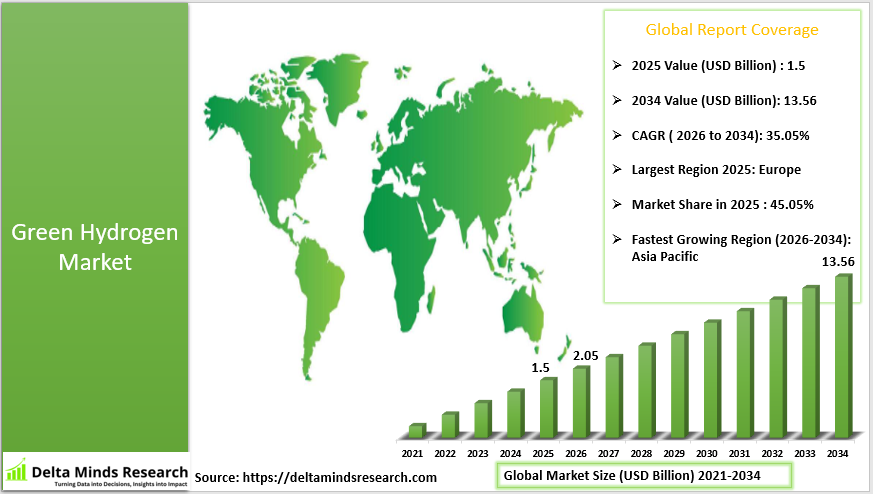
The global Green Hydrogen Market was valued at USD 1.5 Billion in 2025. The market is estimated to grow from USD 2.05 Billion by end of 2026 to USD 13.56 Billion till 2034 growing at a Compound Annual Growth Rate (CAGR) of 35.05% during the forecast period 2026 to 2034. Europe holds the largest market share of 45.05% in 2025.
Green hydrogen is emerging as an important component of the transition toward lower-carbon industrial and energy systems. Produced through water electrolysis using renewable electricity, green hydrogen provides an alternative to hydrogen generated from fossil-fuel-based processes. Its commercial relevance is particularly significant in applications where direct electrification can be technically difficult, including selected steelmaking processes, ammonia production, refining, chemicals, heavy transportation, and hydrogen-derived fuels. The development of the market is increasingly connected with the expansion of renewable power generation. Greater availability of solar and wind electricity is creating opportunities to locate electrolyzers alongside renewable-energy assets, allowing electricity to be converted into hydrogen for industrial consumption, storage, transportation, or further processing into products such as ammonia and synthetic fuels.
Government hydrogen strategies and industrial decarbonization programs are also influencing project development. Public funding, renewable-hydrogen incentives, emissions-reduction policies, and support for electrolyzer manufacturing are encouraging companies to evaluate larger commercial projects.
At the same time, the industry continues to face significant economic and infrastructure constraints. Producing renewable hydrogen competitively requires access to low-cost electricity, while transporting and storing hydrogen can require compression, liquefaction, pipelines, specialized storage systems, or conversion into hydrogen derivatives.
The interaction between these opportunities and constraints is expected to shape the commercialization of green hydrogen through 2034.
Key Green Hydrogen Market Takeaways:
Market Size & Growth
- 2025 Market Size: USD 1.5 Billion.
- 2026 Market Size: USD 2.05 Billion.
- 2034 Market Size: USD 13.56 Billion.
- CAGR (2026-2034): 35.05%.
Regional Leadership
- Largest Market Share Holder Region in 2025: Europe (Holds Market Share of 45.05%).
- Fastest Growing Region during forecast years (2026-2034): Asia Pacific.
List of Key Green Hydrogen Market Companies Profiled in the Report
- Siemens Energy, Nel ASA, ITM Power, Ballard Power Systems, Plug Power, McPhy Energy, Hydrogenics Corporation, Air Products and Chemicals, Inc., Linde PLC (Germany), ENGIE (France).
This report focuses on Green Hydrogen Market revenue at the global, regional, and country level. From global perspective, this report represents overall Green Hydrogen Market size, by analyzing historical data, and prospects. Regionally, this report focuses on Several Key region: North America, Europe, Asia Pacific, South America, and Middle East and Africa.
Key Points Covered in the Report
- Market Revenue of Green Hydrogen Market from 2021 to 2034
- Market Forecast for Green Hydrogen Market from 2026 to 2034
- Regional Market share and revenue from 2021 to 2034
- Countries Level Market share within region from 2021 to 2034
- Company Market share analysis, competitive scenario, ranking, and detailed company profiles.
- Market drivers, Market restraints, and detailed COVID-19 impact on Green Hydrogen Market.
Market Dynamics
The green hydrogen industry is moving from relatively small demonstration projects toward larger commercial developments intended to serve established industrial hydrogen consumers and emerging energy applications.
Decarbonization is a central force behind this transition. Conventional hydrogen production can be carbon intensive when produced from fossil fuels without emissions mitigation. Using renewable electricity to power electrolysis creates an alternative production pathway that can substantially reduce production-related emissions.
This distinction is particularly relevant to industries that already consume large quantities of hydrogen. Refineries, ammonia manufacturers, and chemical producers can potentially substitute renewable hydrogen for conventionally produced hydrogen, while industries such as steelmaking and heavy transportation could create additional sources of demand.
The expansion of solar and wind generation also creates a connection between the renewable-power and hydrogen industries. Electrolyzers can convert renewable electricity into hydrogen, allowing energy to be used in industrial processes or transformed into hydrogen derivatives.
However, producing hydrogen is only one part of the commercial challenge. Projects must also address compression, storage, transportation, infrastructure, electricity supply, water requirements, and long-term demand.
Consequently, successful green hydrogen development will depend on the economics of the entire value chain rather than electrolyzer performance alone.
Green Hydrogen Market Drivers:
Industrial Decarbonization Is Creating New Demand for Renewable Hydrogen
Reducing emissions from energy-intensive industries represents one of the strongest structural drivers of the green hydrogen market.
Industries including steel, refining, fertilizers, chemicals, shipping, and selected heavy-transport applications cannot always achieve deep emissions reductions through direct electrification alone. Hydrogen can provide an alternative energy carrier, industrial feedstock, or reducing agent in some of these applications. Ammonia manufacturing represents an important example. Hydrogen is already an essential input into ammonia production, meaning that renewable hydrogen can potentially replace a carbon-intensive input without fundamentally eliminating the underlying need for hydrogen.
A similar opportunity exists in refining, where hydrogen is used in several processing operations. Steel production represents a potentially transformative longer-term application. Hydrogen-based direct-reduced iron processes can provide an alternative pathway for reducing emissions associated with conventional steelmaking. As governments, customers, investors, and corporations place greater emphasis on supply-chain emissions, demand for materials produced using lower-carbon processes could strengthen the commercial case for renewable hydrogen.
Renewable-Energy Expansion Is Improving the Production Environment
The economics of green hydrogen are closely linked to electricity costs because electrolysis requires substantial amounts of power.
Regions capable of producing inexpensive solar or wind electricity may therefore possess an important competitive advantage. This relationship is encouraging project developers to integrate electrolyzers directly with renewable-generation assets. Instead of treating hydrogen production as an isolated industrial process, developers increasingly evaluate solar generation, wind farms, electrolyzers, storage, water systems, and hydrogen processing as components of an integrated energy project.
Large renewable developments can potentially provide the electricity volumes required for industrial-scale hydrogen production. This model is particularly relevant to markets with high-quality renewable resources, including Australia, the Middle East, India, Latin America, parts of Africa, and selected European locations.
Policy Frameworks Are Supporting Early Commercial Development
Green hydrogen remains an emerging industry in which project economics can be difficult without supportive market conditions.
Governments are therefore using various mechanisms to encourage investment, including production support, capital funding, tax incentives, renewable-hydrogen requirements, industrial decarbonization programs, research funding, and infrastructure investment. Such mechanisms can help reduce the cost gap between renewable hydrogen and established fossil-fuel-based alternatives during the industry’s commercialization phase. Policy support can also stimulate investment beyond hydrogen production itself. Electrolyzer manufacturing, pipelines, storage, ports, refueling infrastructure, renewable-energy generation, and hydrogen derivatives may all benefit from broader hydrogen-development strategies. As projects move from announcements to construction and operation, however, long-term market development will increasingly depend on whether green hydrogen can achieve competitive economics for specific applications.
Green Hydrogen Market Challenges:
Storage and Transportation Remain Major Commercialization Constraints
Hydrogen’s physical characteristics make large-scale storage and transportation more complex than those of many conventional fuels.
Hydrogen has a relatively low volumetric energy density under normal conditions. Moving meaningful quantities can therefore require compression, liquefaction, pipeline transportation, or conversion into another molecule. Each approach introduces different economic and technical considerations.
Compressed hydrogen requires specialized high-pressure equipment. Liquefaction increases density but requires extremely low temperatures and substantial energy input. Pipelines can provide efficient transportation for sufficiently large and stable flows but require major infrastructure investment. Hydrogen can alternatively be converted into ammonia or other carriers for transportation. This may improve logistics for international trade but introduces additional conversion processes and associated energy losses. The optimal transportation model will therefore depend on production scale, distance, end-use requirements, existing infrastructure, and the form in which hydrogen is ultimately consumed.
Production Costs Remain Sensitive to Electricity Economics
Renewable electricity represents a major input into green hydrogen production. Consequently, two otherwise similar electrolyzer projects can produce hydrogen at substantially different costs depending on electricity prices, renewable-resource quality, utilization rates, financing, and system design. Electrolyzer capital costs are important, but reducing equipment prices alone will not necessarily make green hydrogen competitive.
Project developers must optimize the relationship among renewable-generation capacity, electrolyzer utilization, storage, electricity-market participation, and hydrogen demand. This economic sensitivity is one reason green hydrogen development is initially concentrating in regions with strong renewable resources or policy support.
Infrastructure Must Develop Alongside Production Capacity
Large production projects require corresponding infrastructure to connect hydrogen supply with end users. Without pipelines, storage facilities, ports, refueling stations, industrial connections, or conversion infrastructure, additional hydrogen-production capacity may have limited commercial value.
Infrastructure investment can therefore create a coordination challenge: producers require confidence that customers will purchase hydrogen, while customers may hesitate to transition until reliable hydrogen supply and infrastructure exist. Hydrogen hubs and industrial clusters are one potential solution because they can concentrate production, infrastructure, and demand within defined geographic areas.
Green Hydrogen Market Opportunities:
Emerging Economies Could Become Major Production and Consumption Centers
Emerging economies represent an important opportunity because many combine expanding industrial activity with substantial renewable-energy potential. Countries developing new steel, fertilizer, refining, chemical, and manufacturing capacity may have opportunities to integrate lower-carbon hydrogen technologies into future industrial infrastructure. India represents an important example. The country’s combination of rapidly expanding renewable generation and significant industrial hydrogen consumption creates potential demand for green hydrogen in fertilizers, refining, steel, and other industries.
Similar opportunities are developing across Latin America, the Middle East, Africa, and parts of Asia. Rather than simply reproducing the hydrogen systems used by mature economies, these markets could develop integrated renewable-power and hydrogen infrastructure as industrial capacity expands.
International Hydrogen Trade Could Create a New Energy Supply Chain
Not every major hydrogen-consuming economy has equivalent access to inexpensive renewable electricity. This imbalance creates the possibility of international trade between regions capable of producing renewable hydrogen competitively and markets with substantial hydrogen demand. Australia, Chile, Brazil, the Middle East, North Africa, and other renewable-resource-rich locations are evaluating export-oriented projects. Potential importing markets include Europe and several Asian economies.
Because transporting pure hydrogen over very long distances remains challenging, international trade may increasingly involve hydrogen derivatives such as ammonia, methanol, or synthetic fuels. Development of this trade could create opportunities across electrolyzers, renewable generation, conversion plants, ports, storage, specialized vessels, terminals, and hydrogen-processing infrastructure.
Green Ammonia and Hydrogen-Derived Fuels Can Expand Addressable Demand
Hydrogen’s future market opportunity extends beyond direct consumption. Renewable hydrogen can serve as an input for green ammonia, methanol, synthetic hydrocarbons, sustainable fuel pathways, and other hydrogen-derived products. Green ammonia is particularly significant because ammonia already has an established global production and transportation system. Renewable hydrogen can replace conventional hydrogen in ammonia production, while ammonia itself is also being evaluated for additional energy applications.
Hydrogen-derived fuels could similarly provide pathways for reducing emissions in sectors where direct battery electrification is difficult, particularly selected maritime and aviation applications.
Green Hydrogen Market Segmentation Analysis
For this study, we have categories the Green Hydrogen Market By Technology Type, By Distribution Channel Type, By Application Type and By Region.
By Technology Type
Based on Technology Type, the market is segmented into Alkaline Electrolyzer, PEM Electrolyzer, SOEC Electrolyzer.
Alkaline Electrolyzers Accounted for 60.25% of the Market in 2025
The alkaline electrolyzer segment represented approximately 60.25% of green hydrogen market revenue in 2025, making it the largest technology category. Alkaline electrolysis benefits from decades of industrial operating experience. This maturity provides project developers with an established technology base when evaluating large hydrogen-production facilities.
The technology is particularly relevant to high-capacity projects where equipment cost, operating lifetime, scalability, maintainability, and proven performance are major investment considerations. As green hydrogen projects increase from megawatt-scale demonstrations toward installations of several hundred megawatts or more, these characteristics can provide an important advantage. Alkaline systems are therefore expected to remain an important component of large renewable-hydrogen projects serving refining, chemicals, fertilizers, energy, and other industrial applications.
SOEC Technology Is Projected to Record Strong Growth
The Solid Oxide Electrolyzer Cell segment is projected to expand at a CAGR of approximately 39.75% during the forecast period. SOEC systems operate at elevated temperatures and can offer attractive efficiency characteristics when integrated with processes capable of supplying heat. This creates potential applications in industrial environments where hydrogen production can be integrated with existing thermal-energy streams. The technology remains less commercially mature than conventional alkaline electrolysis, and future adoption will depend on improvements in durability, manufacturing scale, materials, operating lifetime, and project economics. Nevertheless, increasing interest in highly efficient hydrogen production is encouraging continued development and demonstration of SOEC technology.
By Distribution Channel Type
Based on Distribution Channel Type, the market is segmented into Pipeline, Cargo.
Pipeline Distribution Held 52.06% of the Market in 2025
The pipeline segment accounted for approximately 52.06% of green hydrogen market revenue in 2025. Pipeline transportation is particularly relevant where large quantities of hydrogen must move continuously between production facilities and industrial consumers. Hydrogen hubs, refining complexes, chemical clusters, steel-production areas, and other concentrated industrial regions can potentially support pipeline networks because multiple producers and consumers can share infrastructure. Future development could involve both purpose-built hydrogen pipelines and, where technically and economically feasible, modification of selected existing gas infrastructure. The viability of individual projects will depend on pipeline materials, pressure requirements, hydrogen purity, distance, flow volumes, regulation, and infrastructure condition.
Cargo Transportation Could Enable International Hydrogen Trade
The cargo segment is projected to expand at approximately 27.65% CAGR during the forecast period. Cargo transportation becomes particularly relevant when hydrogen or hydrogen-derived products must move across oceans or between locations where pipelines are impractical. Several technical pathways are being evaluated, including liquefied hydrogen, ammonia, and liquid organic hydrogen carriers. Ammonia is attracting particular attention because international infrastructure for producing, transporting, and handling ammonia already exists. Export-oriented hydrogen projects could therefore create an increasingly important market for specialized storage, conversion, shipping, terminals, and reconversion technologies.
By Application Type
Based on Application Type, the market is segmented into Power Generation, Transport, Others.
Transport Accounted for 38.65% of the Market in 2025
The transport segment represented approximately 38.65% of global green hydrogen market revenue in 2025. Hydrogen is being evaluated across transportation applications where operating requirements can make complete battery electrification challenging. Potential applications include heavy-duty trucks, buses, selected rail systems, maritime transportation, fleet operations, and other high-utilization vehicles. Hydrogen’s relevance to transportation also extends beyond direct use in fuel cells. Renewable hydrogen can serve as an input for ammonia, methanol, and synthetic fuels that may ultimately be consumed in maritime or aviation applications. The development of hydrogen mobility, however, depends on more than vehicle availability. Refueling infrastructure, hydrogen production, distribution networks, fleet utilization, fuel costs, and vehicle economics must develop together.
Transport Is Also Projected to Expand Rapidly Through 2034
The transport segment is projected to register a CAGR of approximately 25.62% during the forecast period. Growth is expected to be influenced by continued development of hydrogen-powered commercial vehicles, hydrogen refueling networks, maritime fuel pathways, and hydrogen-derived synthetic fuels. Fleet-based applications may provide particularly Favorable early adoption opportunities because vehicles can return regularly to centralized refueling locations, reducing the initial infrastructure required compared with a nationwide retail network.
Green Hydrogen Market Regional Outlook
By Geography, the market is categorized into North America, Europe, Asia Pacific, South America and Middle East and Africa.
North America Green Hydrogen Market Growth & Analysis Report 2026-2034
North America is developing a broader hydrogen ecosystem encompassing renewable hydrogen production, industrial consumption, hydrogen hubs, electrolyzer manufacturing, transportation, and supporting infrastructure. The United States represents the largest center of activity within the region. Proposed and operating projects cover applications including refining, chemicals, fertilizers, transportation, energy storage, and industrial decarbonization.
The development of hydrogen hubs is particularly important because clustering producers and consumers can improve infrastructure utilization and reduce some of the transportation challenges associated with hydrogen. Canada also possesses significant potential due to its renewable-energy resources, established industrial base, and access to international energy markets. Over the forecast period, regional market development will depend on project economics, policy implementation, infrastructure availability, renewable-power costs, and the establishment of long-term hydrogen demand.
United States Green Hydrogen Market
The U.S. market is expected to expand as developers invest in renewable-powered hydrogen facilities, electrolyzer projects, industrial applications, and hydrogen infrastructure. Refining and chemicals provide an existing base of hydrogen consumption, while emerging opportunities are developing across clean fuels, heavy transportation, energy storage, and industrial decarbonization. The ability to connect large renewable-energy resources with existing hydrogen-consuming industries could become an important driver of future U.S. market development.
Europe Green Hydrogen Market Growth & Analysis Report 2026-2034
Europe represented the largest regional green hydrogen market in 2025, accounting for approximately 45.05% of global revenue. The region has positioned renewable hydrogen as one component of its broader industrial decarbonization and energy-transition strategy.
Germany, France, Spain, the Netherlands, and other European countries are developing projects involving electrolyzer capacity, renewable-energy integration, industrial hydrogen use, ports, storage, and transportation infrastructure. European hydrogen demand is expected to originate from multiple sectors, including refining, chemicals, fertilizers, steel, transportation, and hydrogen-derived fuels.
Development of hydrogen infrastructure is especially important because renewable-hydrogen production potential and industrial consumption are geographically uneven. Future European hydrogen networks may therefore connect domestic production, ports, storage facilities, industrial clusters, and potential imports. The region’s long-term leadership will depend increasingly on converting policy ambitions and announced capacity into commercially operating projects with reliable customers.
Asia Pacific Green Hydrogen Market Growth & Analysis Report 2034
Asia Pacific is emerging as one of the most strategically diverse green hydrogen markets. China combines large renewable-energy deployment with substantial electrolyzer manufacturing capability and industrial hydrogen demand.
India is pursuing renewable hydrogen opportunities across fertilizers, refining, steel, mobility, and other industrial applications while rapidly expanding solar and wind generation. Australia possesses substantial renewable-resource potential and is evaluating hydrogen and ammonia production for both domestic use and exports. Japan and South Korea represent another side of the regional market. Their energy strategies include interest in hydrogen and hydrogen-derived fuels, creating potential demand for both domestic projects and international supply chains. These different market structures mean Asia Pacific could become simultaneously a major producer, equipment-manufacturing center, consumer, exporter, and importer of renewable hydrogen.
South America Green Hydrogen Market Growth & Analysis Report 2034
South America is projected to register a CAGR of approximately 80.15% during the forecast period, supported by strong renewable-energy resources and increasing interest in export-oriented hydrogen projects. Chile, Brazil, and Argentina possess substantial renewable-generation potential that could support competitively positioned hydrogen production. Chile’s solar and wind resources create opportunities for large renewable-hydrogen developments, while Brazil combines extensive renewable-energy availability with a large industrial economy and established port infrastructure.
Green ammonia represents a particularly relevant opportunity because renewable hydrogen can be converted into a product that already has established industrial demand and international transportation infrastructure. Future regional development is therefore likely to involve both domestic industrial decarbonization and projects designed around exports. Project execution will depend on renewable-power economics, infrastructure, financing, customer agreements, regulatory frameworks, and access to international markets.
Middle East and Africa Green Hydrogen Market Growth & Analysis Report 2034
The Middle East & Africa is emerging as a potential large-scale production region because of abundant renewable resources and increasing government interest in hydrogen and green-ammonia development. Saudi Arabia, the UAE, and other Middle Eastern markets can combine high-quality solar resources with experience in developing and exporting large energy projects.
This existing expertise in energy infrastructure, ports, project finance, and international commodity markets could support the development of an export-oriented hydrogen industry. Africa also possesses significant renewable-energy potential. Countries including Namibia and other markets with favorable solar or wind conditions are attracting interest in hydrogen developments intended for industrial use and potential exports.
However, realizing this potential will require substantial investment in renewable generation, electrolyzers, water infrastructure, storage, conversion facilities, ports, transportation systems, and supporting electricity networks. The region’s future competitive position will therefore depend not simply on renewable-resource availability but on its ability to develop integrated hydrogen supply chains at commercial scale.
List of Companies Covered in Green Hydrogen Market:
The green hydrogen industry brings together companies from several parts of the energy and industrial value chain rather than operating as a conventional single-product market.
Participants include electrolyzer manufacturers, industrial-gas companies, renewable-energy developers, engineering companies, utilities, infrastructure providers, fuel-cell companies, and integrated energy businesses.
Companies covered in the competitive assessment include Siemens Energy, Nel ASA, ITM Power, Ballard Power Systems, Plug Power, McPhy Energy, Air Products and Chemicals, Linde, ENGIE, and other market participants.
Competition is increasingly centered on more than electrolyzer equipment. Large hydrogen projects require integration across renewable generation, electrolysis, water treatment, compression, storage, conversion, transportation, and industrial consumption.
Companies capable of combining technology with project engineering, financing, infrastructure, long-term service, and access to hydrogen customers may therefore possess advantages as the market progresses toward larger commercial projects. Partnerships and consortium-based project structures are also expected to remain important. The complexity and capital requirements of large hydrogen developments frequently require cooperation among renewable-energy developers, technology providers, industrial customers, infrastructure operators, financial institutions, and public-sector organizations.
Over the forecast period, competitive differentiation is expected to increasingly depend on production economics, electrolyzer efficiency and durability, manufacturing scale, project-execution capability, infrastructure access, technology integration, and the ability to secure long-term hydrogen demand.
The Major Players Covered in the Green Hydrogen Market are:
- Siemens Energy
- Nel ASA
- ITM Power
- Ballard Power Systems
- Plug Power
- McPhy Energy
- Hydrogenics Corporation
- Air Products and Chemicals, Inc.
- Linde PLC (Germany)
- ENGIE (France)
Global Green Hydrogen Market Report Segmentation:
The report projects revenue growth across, global, regional, and country levels, offering a comprehensive analysis of the latest industry trends within each sub-segment from 2021 to 2034. For this study, Delta Minds Research has categories the Green Hydrogen Market by Technology Type, By Distribution Channel Type, By Application Type and by region.
Green Hydrogen Market by Technology Type (Revenue, USD Billion, 2021-2034)
- Alkaline Electrolyzer
- PEM Electrolyzer
- SOEC Electrolyzer
Green Hydrogen Market by Distribution Channel Type (Revenue, USD Billion, 2021-2034)
- Pipeline
- Cargo
Green Hydrogen Market by Application Type (Revenue, USD Billion, 2021-2034)
- Power Generation
- Transport
- Others
Green Hydrogen Market by Regional Analysis (Revenue, USD Billion, 2021-2034)
North America
- United States
- Canada
- Mexico
Europe
- Germany
- United Kingdom
- France
- Italy
- Spain
- Russia
- Switzerland
- Austria
- Belgium
- Rest of Europe
Asia Pacific
- Japan
- China
- India
- Australia
- Thailand
- South Korea
- Vietnam
- Indonesia
- Philippines
- Rest of Asia Pacific
South America
- Brazil
- Argentina
- Rest of South America
Middle East and Africa
- South Africa
- Saudi Arabia
- UAE
- Israel
- Rest of Middle East and Africa.
Market Breakdown
Market Segmentation
Global Green Hydrogen Market Report Segmentation:
The report projects revenue growth across, global, regional, and country levels, offering a comprehensive analysis of the latest industry trends within each sub-segment from 2021 to 2034. For this study, Delta Minds Research has categories the Green Hydrogen Market by Technology Type, By Distribution Channel Type, By Application Type and by region.
Green Hydrogen Market by Technology Type (Revenue, USD Billion, 2021-2034)
- Alkaline Electrolyzer
- PEM Electrolyzer
- SOEC Electrolyzer
Green Hydrogen Market by Distribution Channel Type (Revenue, USD Billion, 2021-2034)
- Pipeline
- Cargo
Green Hydrogen Market by Application Type (Revenue, USD Billion, 2021-2034)
- Power Generation
- Transport
- Others
Green Hydrogen Market by Regional Analysis (Revenue, USD Billion, 2021-2034)
North America
- United States
- Canada
- Mexico
Europe
- Germany
- United Kingdom
- France
- Italy
- Spain
- Russia
- Switzerland
- Austria
- Belgium
- Rest of Europe
Asia Pacific
- Japan
- China
- India
- Australia
- Thailand
- South Korea
- Vietnam
- Indonesia
- Philippines
- Rest of Asia Pacific
South America
- Brazil
- Argentina
- Rest of South America
Middle East and Africa
- South Africa
- Saudi Arabia
- UAE
- Israel
- Rest of Middle East and Africa.
Report Structure
Table of Contents
Table of Contents
Chapter 1: Global Green Hydrogen Market Overview
- Global Green Hydrogen Market Revenue, Market Growth Rate (USD Billion, 2021-2034)
- Global Green Hydrogen Market Revenue Comparison (2025-2034)
- Global Green Hydrogen Market Share Analysis, By Region (2021-2034)
- Global Green Hydrogen Market Analysis, By Technology Type (USD Billion, 2021-2034)
- Alkaline Electrolyzer
- PEM Electrolyzer
- SOEC Electrolyzer
- Global Green Hydrogen Market Analysis, By Distribution Channel Type (USD Billion, 2021-2034)
- Pipeline
- Cargo
- Global Green Hydrogen Market Analysis, By Application Type (USD Billion, 2021-2034)
- Power Generation
- Transport
- Others
Chapter 2: Market Dynamics
- COVID-19 Impact Green Hydrogen Market
- Market Drivers
- Market Restraints
- Market Opportunity
- Market Challenges
- Industry Analysis Tools
- Porter’s Analysis
- PESTEL Analysis
Chapter 3: Competitive Landscape
- Siemens Energy
- Nel ASA
- ITM Power
- Ballard Power Systems
- Plug Power
- McPhy Energy
- Hydrogenics Corporation
- Air Products and Chemicals, Inc.
- Linde PLC (Germany)
- ENGIE (France)
Chapter 4: North America Green Hydrogen Market Revenue & Trend Analysis (2021-2034)
- North America Green Hydrogen Market Revenue, Market Growth Rate (USD Billion, 2021-2034)
- North America Green Hydrogen Market Revenue Comparison (2025-2032)
- North America Green Hydrogen Market Share Analysis, By Region 2025
- North America Green Hydrogen Market Revenue, Market Growth Rate, By Technology Type (USD Billion, 2021-2034)
- North America Green Hydrogen Market Revenue, Market Growth Rate, By Distribution Channel Type (USD Billion, 2021-2034)
- North America Green Hydrogen Market Revenue, Market Growth Rate, By Application Type (USD Billion, 2021-2034)
- United States Green Hydrogen Market Revenue, Market Growth Rate (USD Billion, 2021-2034)
- Canada Green Hydrogen Market Revenue, Market Growth Rate (USD Billion, 2021-2034)
- Mexico Green Hydrogen Market Revenue, Market Growth Rate (USD Billion, 2021-2034)
Chapter 5: Europe Green Hydrogen Market Revenue & Trend Analysis (2021-2034)
- Europe Green Hydrogen Market Revenue, Market Growth Rate (USD Billion, 2021-2034)
- Europe Green Hydrogen Market Revenue Comparison (2025-2034)
- Europe Green Hydrogen Market Share Analysis, By Region 2025
- Europe Green Hydrogen Market Revenue, Market Growth Rate, By Technology Type (USD Billion, 2021-2034)
- Europe Green Hydrogen Market Revenue, Market Growth Rate, By Distribution Channel Type (USD Billion, 2021-2034)
- Europe Green Hydrogen Market Revenue, Market Growth Rate, By Application Type (USD Billion, 2021-2034)
- Germany Green Hydrogen Market Revenue, Market Growth Rate (USD Billion, 2021-2034)
- United Kingdom Green Hydrogen Market Revenue, Market Growth Rate (USD Billion, 2021-2034)
- France Green Hydrogen Market Revenue, Market Growth Rate (USD Billion, 2021-2034)
- Italy Green Hydrogen Market Revenue, Market Growth Rate (USD Billion, 2021-2034)
- Spain Green Hydrogen Market Revenue, Market Growth Rate (USD Billion, 2021-2034)
- Russia Green Hydrogen Market Revenue, Market Growth Rate (USD Billion, 2021-2034)
- Switzerland Green Hydrogen Market Revenue, Market Growth Rate (USD Billion, 2021-2034)
- Austria Green Hydrogen Market Revenue, Market Growth Rate (USD Billion, 2021-2034)
- Belgium Green Hydrogen Market Revenue, Market Growth Rate (USD Billion, 2021-2034)
- Rest of Europe Green Hydrogen Market Revenue, Market Growth Rate (USD Billion, 2021-2034)
Chapter 6: Asia Pacific Green Hydrogen Market Revenue & Trend Analysis (2021-2034)
- Asia Pacific Green Hydrogen Market Revenue, Market Growth Rate (USD Billion, 2021-2034)
- Asia Pacific Green Hydrogen Market Revenue Comparison (2025-2032)
- Asia Pacific Green Hydrogen Market Share Analysis, By Region 2025
- Asia Pacific Green Hydrogen Market Revenue, Market Growth Rate, By Technology Type (USD Billion, 2021-2034)
- Asia Pacific Green Hydrogen Market Revenue, Market Growth Rate, By Distribution Channel Type (USD Billion, 2021-2034)
- Asia Pacific Green Hydrogen Market Revenue, Market Growth Rate, By Application Type (USD Billion, 2021-2034)
- Japan Green Hydrogen Market Revenue, Market Growth Rate (USD Billion, 2021-2034)
- China Green Hydrogen Market Revenue, Market Growth Rate (USD Billion, 2021-2034)
- India Green Hydrogen Market Revenue, Market Growth Rate (USD Billion, 2021-2034)
- Australia Green Hydrogen Market Revenue, Market Growth Rate (USD Billion, 2021-2034)
- Thailand Green Hydrogen Market Revenue, Market Growth Rate (USD Billion, 2021-2034)
- South Korea Green Hydrogen Market Revenue, Market Growth Rate (USD Billion, 2021-2034)
- Rest of Asia Pacific Green Hydrogen Market Revenue, Market Growth Rate (USD Billion, 2021-2034)
Chapter 7: South America Green Hydrogen Market Revenue & Trend Analysis (2021-2034)
- South America Green Hydrogen Market Revenue, Market Growth Rate (USD Billion, 2021-2034)
- South America Green Hydrogen Market Revenue Comparison (2025-2034)
- South America Green Hydrogen Market Share Analysis, By Region 2025
- South America Green Hydrogen Market Revenue, Market Growth Rate, By Technology Type (USD Billion, 2021-2034)
- South America Green Hydrogen Market Revenue, Market Growth Rate, By Distribution Channel Type (USD Billion, 2021-2034)
- South America Green Hydrogen Market Revenue, Market Growth Rate, By Application Type (USD Billion, 2021-2034)
- Brazil Green Hydrogen Market Revenue, Market Growth Rate (USD Billion, 2021-2034)
- Argentina Green Hydrogen Market Revenue, Market Growth Rate (USD Billion, 2021-2034)
- Rest of South America Green Hydrogen Market Revenue, Market Growth Rate (USD Billion, 2021-2034)
Chapter 8: Middle East & Africa Green Hydrogen Market Revenue & Trend Analysis (2021-2034)
- Middle East & Africa Green Hydrogen Market Revenue, Market Growth Rate (USD Billion, 2021-2034)
- Middle East & Africa Green Hydrogen Market Revenue Comparison (2025-2034)
- Middle East & Africa Green Hydrogen Market Share Analysis, By Region 2025
- Middle East & Africa Green Hydrogen Market Revenue, Market Growth Rate, By Technology Type (USD Billion, 2021-2034)
- Middle East & Africa Green Hydrogen Market Revenue, Market Growth Rate, By Distribution Channel Type (USD Billion, 2021-2034)
- Middle East & Africa Green Hydrogen Market Revenue, Market Growth Rate, By Application Type (USD Billion, 2021-2034)
- South Africa Green Hydrogen Market Revenue, Market Growth Rate (USD Billion, 2021-2034)
- Saudi Arabia Green Hydrogen Market Revenue, Market Growth Rate (USD Billion, 2021-2034)
- UAE Green Hydrogen Market Revenue, Market Growth Rate (USD Billion, 2021-2034)
- Kuwait Green Hydrogen Market Revenue, Market Growth Rate (USD Billion, 2021-2034)
- Rest of MEA Green Hydrogen Market Revenue, Market Growth Rate (USD Billion, 2021-2034)
Chapter 9: Appendix
- Research Methodology
- Primary Research
- Secondary Research
- Assumptions & Exclusion
- Disclaimers
Preview before purchasing
Download a Free Sample
Get a complimentary sample containing selected pages, market insights and the report structure.