
Report Overview
Description
Scaffolding Market Size
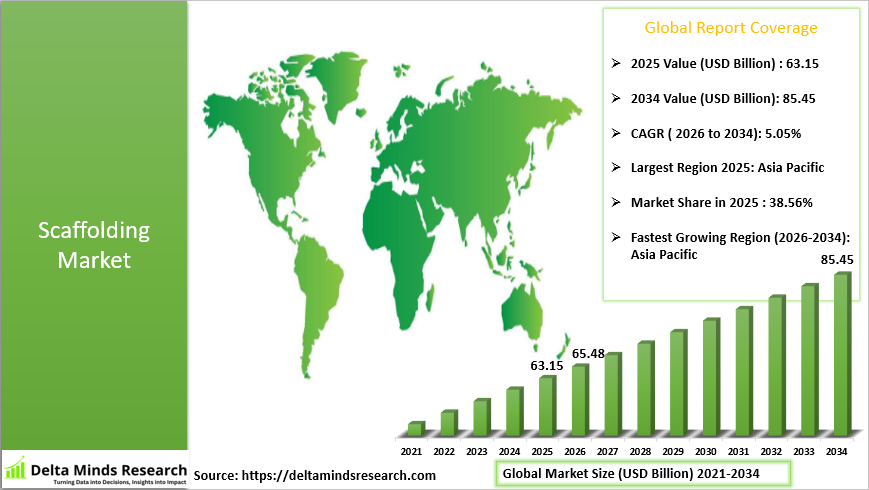
The global scaffolding market was valued at USD 63.15 billion in 2025 and is projected to reach USD 65.48 billion in 2026. By 2034, the market is forecast to generate approximately USD 85.45 billion, expanding at a CAGR of 5.05% during 2026–2034. Asia Pacific represented the largest regional market in 2025, accounting for approximately 38.56% of global revenue.
Scaffolding represents an essential part of temporary access and support infrastructure used across construction, renovation, maintenance, industrial operations, shipbuilding, and other activities requiring safe access to elevated or difficult-to-reach work areas. Although scaffolding is a mature construction technology, the industry continues to evolve as contractors place greater emphasis on worker safety, installation efficiency, modularity, structural performance, and project productivity. Modern scaffolding systems increasingly rely on standardized and modular components that can be configured according to building geometry, project height, load requirements, and site conditions. This flexibility has become particularly important as construction projects become larger and more complex and as renovation activity increases across aging building and infrastructure assets.
Digital technologies are also beginning to influence how temporary access systems are planned and managed. Building Information Modelling (BIM) can allow contractors and scaffolding specialists to incorporate temporary structures into digital project models before physical installation. This can improve coordination between scaffolding layouts, building structures, construction sequencing, material requirements, and other onsite activities. Sensor-based monitoring and digital inspection technologies provide another area of development. Their potential application includes monitoring structural conditions, tracking equipment utilization, documenting inspections, and supporting safety-management processes.
Artificial intelligence and computational design tools could further change scaffolding engineering by allowing project teams to evaluate multiple configurations against variables such as structural loads, material requirements, access routes, installation constraints, and project geometry. However, these technologies remain complementary to engineering judgment, regulatory requirements, and onsite safety procedures rather than replacements for them.
Major participants operating across the global scaffolding ecosystem include Altrad Group, ADTO Group, MJ Gerüst GmbH, BrandSafway, PERI Group, WACO Scaffolding and Equipment, Wellmade Scaffold, United Rentals, Doka, Instant Upright, and other regional manufacturers and rental providers.
Key Scaffolding Market Takeaways:
Market Size & Growth
- 2025 Market Size: USD 63.15 Billion.
- 2026 Market Size: USD 65.48 Billion.
- 2034 Market Size: USD 85.45 Billion.
- CAGR (2026-2034): 5.05%.
Regional Leadership
- Largest Market Share Holder Region in 2025: Asia Pacific (Holds Market Share of 38.56%).
- Fastest Growing Region during forecast years (2026-2034): Asia Pacific.
List of Key Scaffolding Market Companies Profiled in the Report
- Altrad Group (France), ADTO Group (China), MJ Gerust GmbH (Germany), Brand Safway (U.S.), Peri Group (Germany), WACO Scaffolding and Equipment Co. (U.S.), Wellmade Scaffold Co. Ltd. (China), United Rentals (U.S.), Doka GmbH (Austria), Instant Upright (U.K.).
This report focuses on Scaffolding Market revenue at the global, regional, and country level. From global perspective, this report represents overall Scaffolding Market size, by analyzing historical data, and prospects. Regionally, this report focuses on Several Key region: North America, Europe, Asia Pacific, South America, and Middle East and Africa.
Key Points Covered in the Report
- Market Revenue of Scaffolding Market from 2021 to 2034
- Market Forecast for Scaffolding Market from 2026 to 2034
- Regional Market share and revenue from 2021 to 2034
- Countries Level Market share within region from 2021 to 2034
- Company Market share analysis, competitive scenario, ranking, and detailed company profiles.
- Market drivers, Market restraints, and detailed COVID-19 impact on Scaffolding Market.
Market Dynamics
Scaffolding demand is closely connected with the level and composition of construction and maintenance activity.
New buildings require temporary access during structural work, facade installation, finishing, mechanical installation, and other construction stages. Existing buildings create recurring demand through renovation, inspection, repainting, restoration, repair, and facade maintenance.
Infrastructure introduces another substantial application area. Bridges, transportation facilities, industrial structures, power facilities, and other large assets frequently require temporary access systems during construction as well as throughout their operational life.
This means scaffolding demand does not depend entirely on new construction. Mature economies with aging buildings and infrastructure can generate substantial requirements through rehabilitation and maintenance, while developing economies can generate demand through new urban and infrastructure development.
Safety requirements are simultaneously changing customer expectations. Buyers increasingly evaluate scaffolding systems according to structural reliability, ease of assembly, fall protection, load capacity, access design, inspection requirements, and compatibility with applicable safety standards.
These considerations are encouraging manufacturers and rental providers to compete increasingly on complete access solutions rather than individual scaffolding components.
Scaffolding Market Drivers:
Construction and Infrastructure Development Continues to Generate Core Demand
Expansion of residential, commercial, industrial, and public infrastructure remains one of the fundamental drivers of the scaffolding market.
Construction projects require workers to access different heights and sections of a structure throughout multiple stages of development. Scaffolding provides temporary platforms and access routes that can be adapted as construction progresses. Large infrastructure projects can create particularly substantial requirements because bridges, transportation terminals, industrial facilities, public buildings, and other complex structures may require extensive temporary access systems. Urbanization further strengthens this relationship. As cities expand vertically and horizontally, demand develops not only for new buildings but also for roads, railways, utilities, commercial facilities, public infrastructure, and associated maintenance. Consequently, economies experiencing sustained construction investment can generate demand across multiple categories of scaffolding equipment and services.
Building Renovation Creates Recurring Demand Beyond New Construction
The long-term scaffolding opportunity extends considerably beyond newly constructed buildings.
Existing commercial and residential properties require periodic facade repair, repainting, window replacement, roofing work, insulation upgrades, structural inspection, restoration, and general maintenance. Many of these activities require temporary elevated access. This creates a recurring market in mature economies where the pace of new construction may be relatively moderate but the installed base of buildings and infrastructure is substantial. Energy-efficiency renovation could create additional demand. Building owners seeking to improve insulation, replace facade systems, install energy-efficient components, or retrofit older structures may require extensive temporary access during construction.
Increasing Project Complexity Supports Modular Scaffolding Adoption
Construction projects are becoming more complex in terms of geometry, height, sequencing, safety requirements, and coordination among contractors.
Modular scaffolding systems can provide advantages because standardized components can be configured into different structures according to site requirements. These systems can also simplify transportation, inventory management, assembly, dismantling, and reuse across multiple projects. For large contractors and scaffolding rental businesses, equipment utilization is an important economic consideration. Components capable of being reconfigured across different project types can improve asset flexibility and reduce the requirement for highly specialized equipment.
Safety Requirements Influence Equipment Selection
Scaffolding is directly connected with work-at-height safety.
Poor installation, overloaded platforms, inadequate foundations, missing guardrails, improper access, damaged components, or insufficient worker training can create serious workplace hazards. Construction companies therefore increasingly consider the complete scaffolding system rather than simply the cost of individual components. System design, engineering documentation, installation procedures, inspection, worker training, access points, edge protection, and equipment condition can all affect safety performance. Stricter enforcement of occupational safety requirements can consequently support demand for engineered systems, professional installation services, certified components, and regular inspection.
Scaffolding Market Challenges:
Steel and Aluminum Price Volatility Can Affect Project Economics
Steel and aluminum are major materials used across scaffolding equipment, making manufacturers and rental companies sensitive to fluctuations in raw-material prices.
Rapid increases in metal prices can raise manufacturing costs for frames, tubes, platforms, connectors, guardrails, and other components. Manufacturers must then decide whether to absorb these increases, improve production efficiency, or pass additional costs to customers. For rental companies, replacement equipment and fleet expansion can also become more expensive during periods of elevated material prices. Trade restrictions, transportation costs, energy prices, and supply-chain disruption can further influence equipment costs. This creates planning challenges in an industry where customers frequently expect predictable pricing for construction projects with predetermined budgets.
Skilled Installation and Safety Training Remain Critical
Even well-designed scaffolding equipment can create safety risks when assembled or used incorrectly.
Installation requires an understanding of structural loads, anchoring, foundations, bracing, access requirements, platform loading, environmental conditions, and equipment limitations. A shortage of properly trained personnel can therefore become a constraint, particularly in construction markets experiencing rapid expansion. Project schedules can add additional pressure. Contractors working under tight deadlines may attempt to accelerate assembly, modification, or dismantling activities. This increases the importance of formal inspection procedures, qualified supervision, workforce training, and adherence to engineering specifications. For scaffolding companies, investment in workforce capability can consequently become as important as investment in physical equipment.
Scaffolding Market Opportunities:
Renewable-Energy Infrastructure Creates Specialized Access Requirements
The expansion of renewable-energy infrastructure creates new opportunities beyond conventional building construction.
Wind-energy projects require temporary access during turbine installation, inspection, repair, and maintenance. Solar projects can create requirements around supporting electrical and infrastructure work, while transmission and grid-modernization projects can require specialized temporary access solutions. The technical requirements can differ significantly from conventional building scaffolding. Wind turbines, industrial energy facilities, transmission infrastructure, and other energy assets may involve unusual geometries, significant heights, restricted working areas, and specialized safety requirements. This creates opportunities for scaffolding providers capable of combining equipment with engineering, installation, inspection, and project-specific access planning.
Urban Infrastructure and Smart-City Development Can Expand Addressable Demand
Cities worldwide continue to invest in transportation systems, utilities, public buildings, commercial districts, digital infrastructure, and other urban assets.
Many of these projects require temporary access during initial construction and later maintenance. Rail stations, bridges, tunnels, airports, utility infrastructure, public buildings, and high-rise developments can all create substantial scaffolding requirements. Smart-city investment does not necessarily create a completely separate category of scaffolding, but the broader infrastructure development associated with urban modernization can increase demand for sophisticated temporary-access solutions.
Digital Design Can Improve Project Planning and Equipment Utilization
BIM and other digital construction technologies create opportunities to integrate scaffolding planning earlier into project design.
A digitally modelled scaffolding system can help project teams understand how temporary access will interact with permanent structures, cranes, equipment, logistics routes, facade installation, and other construction activities. This can potentially improve material estimation, reduce onsite modifications, identify access conflicts, and support installation planning. For rental providers, digital inventory systems can also improve visibility into equipment location, utilization, inspection status, and availability across multiple projects. As construction becomes increasingly digitized, temporary-access providers capable of integrating with contractor workflows may develop stronger competitive differentiation.
Scaffolding Market Segmentation Analysis
For this study, we have categories the Scaffolding Market By Type, By Material Type, By End User Type and By Region.
By Type
Based on Type, the market is segmented into Supported Scaffolding, Suspended Scaffolding, Rolling Scaffolding.
Supported Scaffolding Accounted for 51.05% of the Market in 2025
The supported scaffolding segment represented approximately 51.05% of global market revenue in 2025, making it the largest type category. Supported scaffolding is constructed from the ground upward and can be configured according to building height, facade geometry, working-load requirements, and available site space. Its versatility supports extensive use across residential buildings, commercial developments, industrial projects, infrastructure construction, renovation, and maintenance. Another advantage is its ability to create continuous working platforms across relatively large areas. This can support activities requiring workers, tools, and construction materials to remain at elevation for extended periods. Modular configurations also allow supported systems to be adapted as construction progresses. These characteristics are expected to maintain the segment’s strong position throughout the forecast period.
Suspended Scaffolding Supports High-Rise and Facade Applications
Suspended scaffolding provides access from above rather than relying entirely on a ground-supported structure. This architecture can be useful where ground-level space is restricted or where workers require access to specific vertical sections of a building. Applications include facade repair, window work, painting, exterior cleaning, inspection, and maintenance of tall structures. Increasing numbers of high-rise buildings and recurring facade-maintenance requirements can therefore support demand for suspended-access systems.
Rolling Scaffolding Provides Flexibility for Repetitive Maintenance Tasks
Rolling scaffolding is designed to be repositioned within a work environment without complete dismantling. This makes it particularly useful for applications where workers repeatedly move between different work areas at similar heights. Warehouses, industrial facilities, commercial buildings, interior construction, electrical installation, and maintenance operations represent common applications. Mobility can improve productivity by reducing the time required to dismantle and rebuild access equipment between nearby work areas.
By Material Type
Based on Material Type, the market is segmented into Steel, Aluminum, Wood, Others.
Steel Accounted for 48.01% of the Market in 2025
The steel segment represented approximately 48.01% of global scaffolding market revenue in 2025, making it the dominant material category.
Steel provides high structural strength and load-bearing capability, making it particularly suitable for demanding construction and industrial applications. Large building projects, bridges, industrial facilities, infrastructure, and other heavy-duty applications can require scaffolding capable of supporting substantial loads while maintaining structural stability. Steel components can also provide long service lives when properly maintained, which is important for rental businesses and contractors that reuse scaffolding fleets across multiple projects.
The material’s established supply chain and widespread familiarity among contractors further reinforce its market position.
Aluminum Is Gaining Importance in Lightweight Applications
Aluminum offers a substantially different value proposition.
Its lower weight makes individual components easier to transport, handle, assemble, and reposition. This can provide productivity benefits in applications where equipment must be moved frequently. Aluminum also provides corrosion resistance, supporting use in maintenance, painting, commercial interiors, and other applications where lightweight equipment is desirable. These characteristics are supporting increasing adoption of aluminum scaffolding in selected applications.
Alternative Materials Serve Specialized Requirements
Wood and bamboo continue to be used in selected construction markets, particularly where local building practices and material availability support their use. Other materials, including fiberglass-based scaffolding components, address more specialized requirements.
Fiberglass can be particularly relevant where electrical conductivity creates a safety concern, making non-conductive access equipment useful for certain electrical and industrial applications.
By End User Type
Based on End User Type, the market is segmented into Construction Industry, Electrical Maintenance, Ship Building, Others.
Construction Industry Accounted for 68.05% of the Market in 2025
The construction industry represented approximately 68.05% of global scaffolding market revenue in 2025, making it the largest end-user category.
Scaffolding is required across numerous stages of residential, commercial, industrial, and infrastructure construction. Workers require elevated access during structural construction, facade installation, masonry, painting, mechanical work, finishing, inspection, repair, and other activities. The broad range of construction applications explains the segment’s substantial share of overall scaffolding demand. Infrastructure development adds further demand through bridges, transportation facilities, public buildings, industrial assets, and other structures requiring temporary access during construction or maintenance.
Electrical Maintenance Requires Specialized Access Solutions
Electrical installation and maintenance can require access systems designed for environments where electrical hazards are present. Non-conductive materials may be preferred for certain applications, while compact and mobile scaffolding can provide access to overhead electrical infrastructure within industrial and commercial facilities. As buildings and industrial facilities incorporate increasingly complex electrical systems, maintenance-related access requirements can create recurring demand.
Shipbuilding Requires Durable and Adaptable Scaffolding Systems
Shipbuilding and vessel maintenance create unusual access requirements because workers must reach curved surfaces, hull sections, internal compartments, and other complex areas. Scaffolding systems used in marine environments must also operate under demanding conditions and may require frequent configuration changes as work progresses. Construction of new vessels, ship repair, maintenance, painting, and inspection therefore represent specialized applications for scaffolding equipment and services.
Scaffolding Market Regional Outlook
By Geography, the market is categorized into North America, Europe, Asia Pacific, South America and Middle East and Africa.
North America Scaffolding Market Growth & Analysis Report 2026-2034
The North American scaffolding market was valued at approximately USD 16.58 billion in 2025 and is projected to reach approximately USD 19.05 billion in 2026. Demand across the region is supported by new construction, infrastructure modernization, commercial and industrial maintenance, building renovation, and requirements for professional temporary-access systems. The United States represents the largest market within North America due to the scale of its construction and industrial economy. Infrastructure renewal creates an important source of demand. Bridges, transportation facilities, utilities, industrial assets, public buildings, and other aging infrastructure require recurring inspection, rehabilitation, and maintenance. Construction safety requirements also influence equipment selection and service models. Contractors operating on complex projects increasingly require engineered access systems accompanied by installation, inspection, and technical support.
The U.S. scaffolding market was valued at approximately USD 12.68 billion in 2025. Canada and Mexico provide additional opportunities through construction, industrial investment, infrastructure development, energy projects, and maintenance activities.
Europe Scaffolding Market Growth & Analysis Report 2026-2034
Europe’s scaffolding market was valued at approximately USD 15.70 billion in 2025 and is projected to reach approximately USD 18.05 billion in 2026. European demand is supported by a combination of new construction and substantial renovation requirements associated with an extensive installed base of buildings and infrastructure. Building refurbishment is particularly important. Facade restoration, insulation upgrades, roof work, heritage restoration, energy-efficiency improvements, and structural maintenance can all require temporary access systems. Industrial maintenance and shipbuilding create additional demand in several European markets. The expansion of renewable-energy infrastructure and building-energy renovation can further increase temporary-access requirements across wind projects, energy facilities, commercial properties, and residential buildings. Within the region, the United Kingdom market was valued at approximately USD 4.50 billion in 2025, while Germany represented approximately USD 3.26 billion.
Asia Pacific Scaffolding Market Growth & Analysis Report 2034
Asia Pacific represents the largest regional scaffolding market, supported by substantial construction activity, infrastructure development, industrial expansion, and continued urbanization. China and India are particularly important because of the scale of residential construction, transportation infrastructure, industrial facilities, commercial development, and public works. Rapid urban expansion creates scaffolding demand across high-rise residential buildings, commercial properties, transportation infrastructure, industrial facilities, and municipal projects. Industrial development adds another layer of demand through factories, energy facilities, refineries, manufacturing plants, and other assets requiring both construction-stage and recurring maintenance access. Japan represents a different demand structure, with renovation, infrastructure maintenance, industrial facilities, and building rehabilitation contributing substantially to market activity.
According to the supplied market estimates, Japan represented approximately USD 3.65 billion in 2025, while India accounted for approximately USD 8.15 billion and China approximately USD 13.02 billion. Over the forecast period, Asia Pacific’s scaffolding industry is expected to remain closely connected with infrastructure spending, urban construction, industrialization, safety standards, and the transition toward more modular and engineered access systems.
South America Scaffolding Market Growth & Analysis Report 2034
South America’s scaffolding market is supported by construction, mining, industrial facilities, energy infrastructure, commercial development, and maintenance activities. Brazil represents an important market due to the size of its construction and industrial economy. Infrastructure investment, industrial maintenance, energy projects, and urban development can generate demand across both scaffolding equipment and rental services. Argentina and other South American economies provide additional opportunities associated with industrial, infrastructure, mining, and energy projects. The rental model can be particularly attractive for contractors seeking access to specialized scaffolding equipment without maintaining large permanent fleets. Future regional expansion will depend on construction investment, infrastructure spending, industrial activity, financing conditions, and broader economic development.
Middle East and Africa Scaffolding Market Growth & Analysis Report 2034
The Middle East & Africa provides a diverse set of opportunities across large construction projects, energy infrastructure, industrial facilities, urban development, mining, and maintenance. Saudi Arabia and the UAE represent important Middle Eastern markets due to continued investment in commercial developments, transportation infrastructure, industrial facilities, tourism projects, and large urban developments. Energy-sector activity also creates substantial scaffolding requirements. Refineries, petrochemical facilities, power plants, renewable-energy projects, and other industrial assets require temporary access during construction as well as scheduled maintenance. Across Africa, demand varies significantly by country. South Africa represents an important industrial and construction market, while infrastructure, mining, energy, and urban development create opportunities in other economies. Long-term regional market development will depend on construction pipelines, industrial investment, infrastructure funding, workforce availability, and adoption of formal safety and access standards.
List of Companies Covered in Scaffolding Market:
The global scaffolding market includes equipment manufacturers, rental businesses, engineering companies, temporary-access specialists, and construction-service providers. Major participants include Altrad Group, ADTO Group, MJ Gerüst GmbH, BrandSafway, PERI Group, WACO Scaffolding and Equipment, Wellmade Scaffold, United Rentals, Doka, Instant Upright, and other regional suppliers.
Competition extends beyond the sale of scaffolding components. Large contractors increasingly require complete access solutions encompassing system design, engineering, equipment supply, transportation, erection, modification, inspection, dismantling, and project support. Rental services therefore represent an important component of the competitive environment. Renting allows contractors to obtain project-specific equipment without committing capital to permanent fleets while giving specialist providers opportunities to generate recurring revenue from the same assets.
Manufacturers are also developing modular systems that improve assembly efficiency, load performance, adaptability, and worker protection. Digitalization provides another potential differentiator. BIM-compatible design, digital equipment tracking, inspection records, asset-management platforms, and data-supported planning can improve both customer experience and fleet utilization. Over the forecast period, competitive positioning is expected to depend increasingly on equipment quality, safety performance, engineering capabilities, rental-fleet availability, geographic service coverage, installation expertise, digital integration, project execution, and the ability to support complex temporary-access requirements.
The Major Players Covered in the Scaffolding Market are:
- Altrad Group (France)
- ADTO Group (China)
- MJ Gerust GmbH (Germany)
- Brand Safway (U.S.)
- Peri Group (Germany)
- WACO Scaffolding and Equipment Co. (U.S.)
- Wellmade Scaffold Co. Ltd. (China)
- United Rentals (U.S.)
- Doka GmbH (Austria)
- Instant Upright (U.K.)
Global Scaffolding Market Report Segmentation:
The report projects revenue growth across, global, regional, and country levels, offering a comprehensive analysis of the latest industry trends within each sub-segment from 2021 to 2034. For this study, Delta Minds Research has categories the Scaffolding Market by Type, By Material Type, By End User Type and by region.
Scaffolding Market by Type (Revenue, USD Billion, 2021-2034)
- Supported Scaffolding
- Suspended Scaffolding
- Rolling Scaffolding
Scaffolding Market by Material Type (Revenue, USD Billion, 2021-2034)
- Steel
- Aluminum
- Wood
- Others
Scaffolding Market by End User Type (Revenue, USD Billion, 2021-2034)
- Construction Industry
- Electrical Maintenance
- Ship Building
- Others
Scaffolding Market by Regional Analysis (Revenue, USD Billion, 2021-2034)
North America
- United States
- Canada
- Mexico
Europe
- Germany
- United Kingdom
- France
- Italy
- Spain
- Russia
- Switzerland
- Austria
- Belgium
- Rest of Europe
Asia Pacific
- Japan
- China
- India
- Australia
- Thailand
- South Korea
- Vietnam
- Indonesia
- Philippines
- Rest of Asia Pacific
South America
- Brazil
- Argentina
- Rest of South America
Middle East and Africa
- South Africa
- Saudi Arabia
- UAE
- Israel
- Rest of Middle East and Africa.
Market Breakdown
Market Segmentation
Global Scaffolding Market Report Segmentation:
The report projects revenue growth across, global, regional, and country levels, offering a comprehensive analysis of the latest industry trends within each sub-segment from 2021 to 2034. For this study, Delta Minds Research has categories the Scaffolding Market by Type, By Material Type, By End User Type and by region.
Scaffolding Market by Type (Revenue, USD Billion, 2021-2034)
- Supported Scaffolding
- Suspended Scaffolding
- Rolling Scaffolding
Scaffolding Market by Material Type (Revenue, USD Billion, 2021-2034)
- Steel
- Aluminum
- Wood
- Others
Scaffolding Market by End User Type (Revenue, USD Billion, 2021-2034)
- Construction Industry
- Electrical Maintenance
- Ship Building
- Others
Scaffolding Market by Regional Analysis (Revenue, USD Billion, 2021-2034)
North America
- United States
- Canada
- Mexico
Europe
- Germany
- United Kingdom
- France
- Italy
- Spain
- Russia
- Switzerland
- Austria
- Belgium
- Rest of Europe
Asia Pacific
- Japan
- China
- India
- Australia
- Thailand
- South Korea
- Vietnam
- Indonesia
- Philippines
- Rest of Asia Pacific
South America
- Brazil
- Argentina
- Rest of South America
Middle East and Africa
- South Africa
- Saudi Arabia
- UAE
- Israel
- Rest of Middle East and Africa.
Report Structure
Table of Contents
Table of Contents
Chapter 1: Global Scaffolding Market Overview
- Global Scaffolding Market Revenue, Market Growth Rate (USD Billion, 2021-2034)
- Global Scaffolding Market Revenue Comparison (2025-2034)
- Global Scaffolding Market Share Analysis, By Region (2021-2034)
- Global Scaffolding Market Analysis, By Type (USD Billion, 2021-2034)
- Supported Scaffolding
- Suspended Scaffolding
- Rolling Scaffolding
- Global Scaffolding Market Analysis, By Material Type (USD Billion, 2021-2034)
- Steel
- Aluminum
- Wood
- Others
- Global Scaffolding Market Analysis, By End User Type (USD Billion, 2021-2034)
- Construction Industry
- Electrical Maintenance
- Ship Building
- Others
Chapter 2: Market Dynamics
- COVID-19 Impact Scaffolding Market
- Market Drivers
- Market Restraints
- Market Opportunity
- Market Challenges
- Industry Analysis Tools
- Porter’s Analysis
- PESTEL Analysis
Chapter 3: Competitive Landscape
- Altrad Group (France)
- ADTO Group (China)
- MJ Gerust GmbH (Germany)
- Brand Safway (U.S.)
- Peri Group (Germany)
- WACO Scaffolding and Equipment Co. (U.S.)
- Wellmade Scaffold Co. Ltd. (China)
- United Rentals (U.S.)
- Doka GmbH (Austria)
- Instant Upright (U.K.)
Chapter 4: North America Scaffolding Market Revenue & Trend Analysis (2021-2034)
- North America Scaffolding Market Revenue, Market Growth Rate (USD Billion, 2021-2034)
- North America Scaffolding Market Revenue Comparison (2025-2032)
- North America Scaffolding Market Share Analysis, By Region 2025
- North America Scaffolding Market Revenue, Market Growth Rate, By Type (USD Billion, 2021-2034)
- North America Scaffolding Market Revenue, Market Growth Rate, By Material Type (USD Billion, 2021-2034)
- North America Scaffolding Market Revenue, Market Growth Rate, By End User Type (USD Billion, 2021-2034)
- United States Scaffolding Market Revenue, Market Growth Rate (USD Billion, 2021-2034)
- Canada Scaffolding Market Revenue, Market Growth Rate (USD Billion, 2021-2034)
- Mexico Scaffolding Market Revenue, Market Growth Rate (USD Billion, 2021-2034)
Chapter 5: Europe Scaffolding Market Revenue & Trend Analysis (2021-2034)
- Europe Scaffolding Market Revenue, Market Growth Rate (USD Billion, 2021-2034)
- Europe Scaffolding Market Revenue Comparison (2025-2034)
- Europe Scaffolding Market Share Analysis, By Region 2025
- Europe Scaffolding Market Revenue, Market Growth Rate, By Type (USD Billion, 2021-2034)
- Europe Scaffolding Market Revenue, Market Growth Rate, By Material Type (USD Billion, 2021-2034)
- Europe Scaffolding Market Revenue, Market Growth Rate, By End User Type (USD Billion, 2021-2034)
- Germany Scaffolding Market Revenue, Market Growth Rate (USD Billion, 2021-2034)
- United Kingdom Scaffolding Market Revenue, Market Growth Rate (USD Billion, 2021-2034)
- France Scaffolding Market Revenue, Market Growth Rate (USD Billion, 2021-2034)
- Italy Scaffolding Market Revenue, Market Growth Rate (USD Billion, 2021-2034)
- Spain Scaffolding Market Revenue, Market Growth Rate (USD Billion, 2021-2034)
- Russia Scaffolding Market Revenue, Market Growth Rate (USD Billion, 2021-2034)
- Switzerland Scaffolding Market Revenue, Market Growth Rate (USD Billion, 2021-2034)
- Austria Scaffolding Market Revenue, Market Growth Rate (USD Billion, 2021-2034)
- Belgium Scaffolding Market Revenue, Market Growth Rate (USD Billion, 2021-2034)
- Rest of Europe Scaffolding Market Revenue, Market Growth Rate (USD Billion, 2021-2034)
Chapter 6: Asia Pacific Scaffolding Market Revenue & Trend Analysis (2021-2034)
- Asia Pacific Scaffolding Market Revenue, Market Growth Rate (USD Billion, 2021-2034)
- Asia Pacific Scaffolding Market Revenue Comparison (2025-2032)
- Asia Pacific Scaffolding Market Share Analysis, By Region 2025
- Asia Pacific Scaffolding Market Revenue, Market Growth Rate, By Type (USD Billion, 2021-2034)
- Asia Pacific Scaffolding Market Revenue, Market Growth Rate, By Material Type (USD Billion, 2021-2034)
- Asia Pacific Scaffolding Market Revenue, Market Growth Rate, By End User Type (USD Billion, 2021-2034)
- Japan Scaffolding Market Revenue, Market Growth Rate (USD Billion, 2021-2034)
- China Scaffolding Market Revenue, Market Growth Rate (USD Billion, 2021-2034)
- India Scaffolding Market Revenue, Market Growth Rate (USD Billion, 2021-2034)
- Australia Scaffolding Market Revenue, Market Growth Rate (USD Billion, 2021-2034)
- Thailand Scaffolding Market Revenue, Market Growth Rate (USD Billion, 2021-2034)
- South Korea Scaffolding Market Revenue, Market Growth Rate (USD Billion, 2021-2034)
- Rest of Asia Pacific Scaffolding Market Revenue, Market Growth Rate (USD Billion, 2021-2034)
Chapter 7: South America Scaffolding Market Revenue & Trend Analysis (2021-2034)
- South America Scaffolding Market Revenue, Market Growth Rate (USD Billion, 2021-2034)
- South America Scaffolding Market Revenue Comparison (2025-2034)
- South America Scaffolding Market Share Analysis, By Region 2025
- South America Scaffolding Market Revenue, Market Growth Rate, By Type (USD Billion, 2021-2034)
- South America Scaffolding Market Revenue, Market Growth Rate, By Material Type (USD Billion, 2021-2034)
- South America Scaffolding Market Revenue, Market Growth Rate, By End User Type (USD Billion, 2021-2034)
- Brazil Scaffolding Market Revenue, Market Growth Rate (USD Billion, 2021-2034)
- Argentina Scaffolding Market Revenue, Market Growth Rate (USD Billion, 2021-2034)
- Rest of South America Scaffolding Market Revenue, Market Growth Rate (USD Billion, 2021-2034)
Chapter 8: Middle East & Africa Scaffolding Market Revenue & Trend Analysis (2021-2034)
- Middle East & Africa Scaffolding Market Revenue, Market Growth Rate (USD Billion, 2021-2034)
- Middle East & Africa Scaffolding Market Revenue Comparison (2025-2034)
- Middle East & Africa Scaffolding Market Share Analysis, By Region 2025
- Middle East & Africa Scaffolding Market Revenue, Market Growth Rate, By Type (USD Billion, 2021-2034)
- Middle East & Africa Scaffolding Market Revenue, Market Growth Rate, By Material Type (USD Billion, 2021-2034)
- Middle East & Africa Scaffolding Market Revenue, Market Growth Rate, By End User Type (USD Billion, 2021-2034)
- South Africa Scaffolding Market Revenue, Market Growth Rate (USD Billion, 2021-2034)
- Saudi Arabia Scaffolding Market Revenue, Market Growth Rate (USD Billion, 2021-2034)
- UAE Scaffolding Market Revenue, Market Growth Rate (USD Billion, 2021-2034)
- Kuwait Scaffolding Market Revenue, Market Growth Rate (USD Billion, 2021-2034)
- Rest of MEA Scaffolding Market Revenue, Market Growth Rate (USD Billion, 2021-2034)
Chapter 9: Appendix
- Research Methodology
- Primary Research
- Secondary Research
- Assumptions & Exclusion
- Disclaimers
Preview before purchasing
Download a Free Sample
Get a complimentary sample containing selected pages, market insights and the report structure.